This years Top Wine Classification provides an assessment of wine quality and interest value between 2010 and 2019. The requirement is for consistently good performance over a ten year period.
To be eligible for the Classification, updated annually since 2004, wines must have earned good to excellent reviews for at least three vintages during the 10-year period under review. The focus is on the country’s leading outfits, those regularly on top form, their wines judged top-notch again and again, year after year. The critics include experts appointed for the Decanter World Wine Awards (UK), the International Wine Challenge (UK) and IWSC (UK), Platter’s SA Wine Guide (5 Stars and Highly Recommended), the Six Nations Wine Challenge (AU), the Trophy Wine Show (SA), the Veritas Awards (SA) and the Michelangelo awards (SA) – to mention just some of the panels.
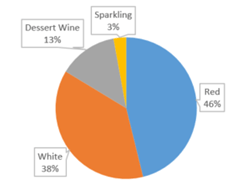
My first thought on looking at the above chart was, “Oh, but that’s just representative of wine production in South Africa.” But on a closer look at the statistics, I found it was not so. In 2019, 32% of wine produced in South Africa was red and 68% was white. It therefore stands to reason that our red wines are of higher quality, if 46 of the top 100 wines were red.
Wine buying tip 1: Buy Red wine
The Cap Classiques making you the 3% of top wines in the sparkling category is slightly more than production. Dessert style wines are also slightly over represented.
Wine buying tip 2: Buy Cap Classique, Cape Vintage Port and Noble Late Harvest
I am pleased (smug) to say this aligns with my pallet and my wine collection. I very seldom buy white wine. But if I were going to buy these wines, which varietals or styles would I buy?
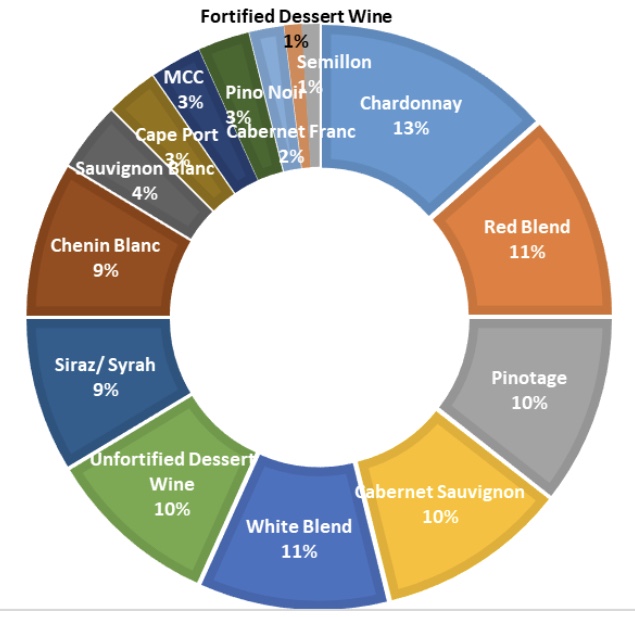
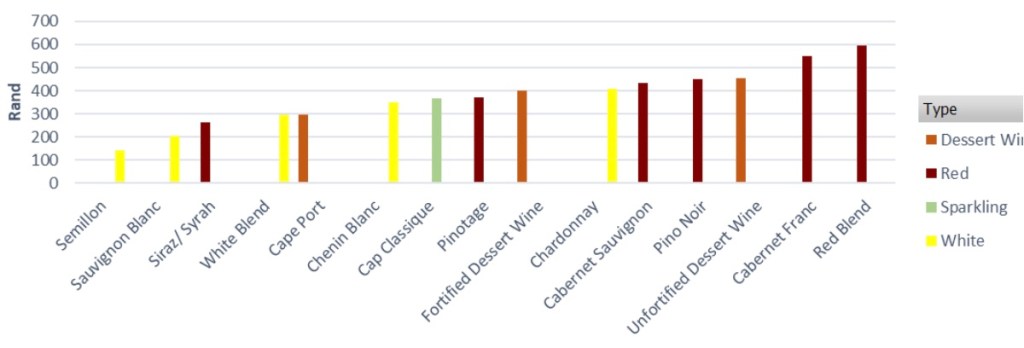
I put these two graphs next to each other because, if you are anything like me, you are probably also looking for maximum bang for your buck. Don’t get me wrong, none of these wines are cheap – I know my dad would have a heart attack seeing these prices! But if you were going to fork out the money what would be a good bet?
From the above Chardonnay (around R400) and a red blend (around R600) would be likely to deliver good quality but with quite a hefty price tag. The hefty price tag might be justified given the aging potential of a red blend and these days you might also want to age a Chardonnay. I like the Pinotage option. It is less expensive (just over R300) and still quite likely to be a top wine.
I have become quite a fan of South African Shiraz which comes in at the lowest average price in the red wines. Depending what you are looking for, these wines can be aged longer than a Pinotage but some come with gentle tannins and a screw top for enjoying now (Eagles Nest, De Gredndal).
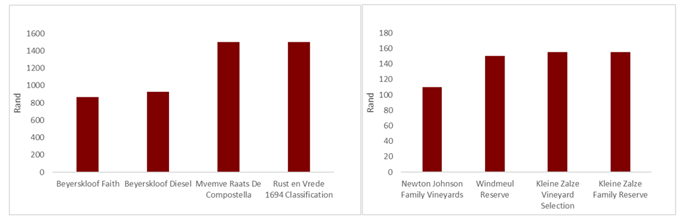
As can be seen above the spread in cost across these top red wines is substantial. Good wines can be bought for under R150 a bottle but if you are looking to impress, you might spend ten times that! Three out of the four top reds are Red Blends.
Dessert wines of all types have excellent aging potential. If you are looking for something special to put away for a long time, the Cape Vintage Ports are a good option. That being said, Nederburg Winemaster’s Nobel Late Harvest is a great option at R130 a bottle (you might even want to drink it now). Of course if what you are looking for is to impress Klein Constantia’s Vin de Constance (R1,189) often sells out and would make a great investment.
Some wine farms performed well across a variety of categories.
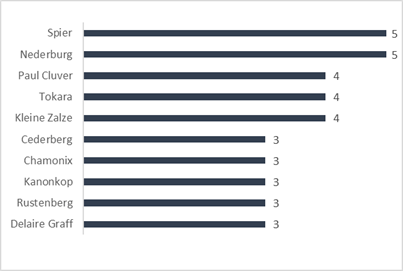
Spier and Nederburg each had five wines in the top 100. Both are reasonably priced, aside from the Ultra Premium wines, where they charge a premium. Kleine Zalze’s wines are probably the best value for money and four make the cut.
So overall, which wine would I buy if I could buy only one? It would definitely be a Kleine Zalze Cabertnet Sauvingnon. But with two in the Top 100 it is a difficult choice. Here I referred to Platters: nope, both had 4.5 stars in 2018, ratings out of 100 scored 93(Family Reserve) and 94(Vinyard Selection), so only a very slight differentiation. So let me try Vivino. On Vivino the Vineyar Selection scores an average of 3.9 out of 5 whereas the Family Reserve scores 4.2. Marginal again. So if pushed to choose, I would go for the Kleine Zalze Family Reserve Cabernet Sauvignon. I trust the the ratings of everyday consumerson Vivino a little more than the wine snobs on the Platters panel. I think this wine is both good value for money and a great wine to age, perhaps making it a good candidate as an investment wine.

Here is the full list:
TOP 100 – 2020 CLASSIFICATION
WHITE WINES
CHARDONNAY
Chamonix Reserve
DeMorgenzon Reserve
Eikendal
Groot Constantia
Hamilton Russell
Jordan Barrel Fermented
Jordan Nine Yards
Kershaw
Oak Valley Groenlandberg
Paul Cluver Estate
Paul Cluver Seven Flags
Rustenberg Five Soldiers
Tokara Reserve Collection Stellenbosch
Uva Mira Single Tree
CHENIN BLANC
Beaumont Hope Marguerite
Botanica
DeMorgenzon Reserve
Ken Forrester FMC
Kleine Zalze Family Reserve Old Bush Vine
Perdeberg Dry Land Collection Barrel Fermented
Sadie Skurfberg
Spier 21 Gables
Stellenrust Barrel Fermented
SAUVIGNON BLANC
Cape Point Reserve
Ghost Corner (Cederberg)
Kleine Zalze Family Reserve Sur Lie
Tokara Reserve Collection Elgin
SEMILLON
KWV Mentors
WHITE BLENDS
Cape Point Isliedh
Constantia Glen Two
Flagstone Treaty Tree Sauvignon Blanc Semillon
Mullineux Old Vines
Nederburg Ingenuity
Nitida Coronata Integration
Rall
Sadie Palladius
Spier Creative Block 2
Tokara Director’s Reserve
Vergelegen G.V.B
SPARKLING WINES
CAP CLASSIQUE
Desiderius Pongrácz (JC Le Roux)
Graham Beck Brut Blanc de Blancs
Villiera Monro Brut
RED WINES
CABERNET FRANC
Raats Family
Warwick
CABERNET SAUVIGNON
Cederberg Five Generations
Delaire Graff Reserve
Eikendal
Kanonkop
Kleine Zalze Family Reserve
Kleine Zalze Vineyard Selection
Nederburg Two Centuries
Neil Ellis Jonkershoek
Rustenberg Peter Barlow
Stark-Condé Three Pines
MERLOT
Shannon Mount Bullet
PINOT NOIR
Chamonix Reserve
Newton Johnson Family Vineyards
Paul Cluver Seven Flags
PINOTAGE
Beyerskloof Diesel
Diemersdal Reserve
Diemersfontein Carpe Diem Reserve
Flagstone Writer’s Block
Kanonkop
Rijk’s Private Cellar
Rijk’s Reserve
Simonsig Redhill
Spier 21 Gables
Wildekrans Barrel Select Reserve
Windmeul Reserve
SHIRAZ / SYRAH
Boekenhoutskloof Syrah
Cederberg
De Grendel
Driehoek
Eagles’ Nest
Hartenberg Gravel Hill
Reyneke Reserve Red
Rustenberg Buzzard Kloof Syrah
Saronsberg
RED BLENDS
Beyerskloof Faith
Chamonix Reserve Troika
Delaire Graff Botmaskop
Kanonkop Paul Sauer
KWV Mentors Orchestra
La Motte Pierneef Syrah Viognier
Mvemve Raats De Compostella
Rust en Vrede 1694 Classification
Saronsberg Full Circle
Spier Creative Block 3
Spier Creative Block 5
Tokara Director’s Reserve
SWEET WINES
UNFORTIFIED DESSERT
Delheim Edelspatz Noble Late Harvest
Fairview La Beryl Blanc (Straw Wine)
Fleur du Cap Noble Late Harvest (Bergkelder)
Groot Constantia Grand Constance (Natural Sweet)
Klein Constantia Vin de Constance Natural Sweet
Mullineux Straw Wine
Nederburg Edelkeur Chenin Blanc Noble Late Harvest
Nederburg Eminence Noble Late Harvest Muscadel
Nederburg Winemasters Noble Late Harvest
Paul Cluver Riesling Noble Late Harvest
FORTIFIED DESSERT
Nuy White Muscadel
CAPE PORT
Boplaas Cape Vintage Reserve
De Krans Cape Vintage Reserve
Delaire Graff Cape Vintage
 Don’t Cry Over Spilt Wine