It has been two weeks since the President announced that a ban on liquor sales and transport would be reintroduced. In post, I wrote about the devastating impact this would have on the wine industry and the surrounding local economy in the Eastern Cape. It seems that this is already starting to take place.
This week The Faremers’ Weekly wrote about how large cellars we’re canceling grape orders for 2021. Lower yield vineyards and those infected with viruses were excluded from orders. With Restuarant trade of liquor banned, the demand for high end wine has fallen.
We have already heard how wineries are struggling to bottle their 2020 vintage because of the lack of floor space caused by previous vintages. The surplus of wine is expected to equate domestic wine consumption.
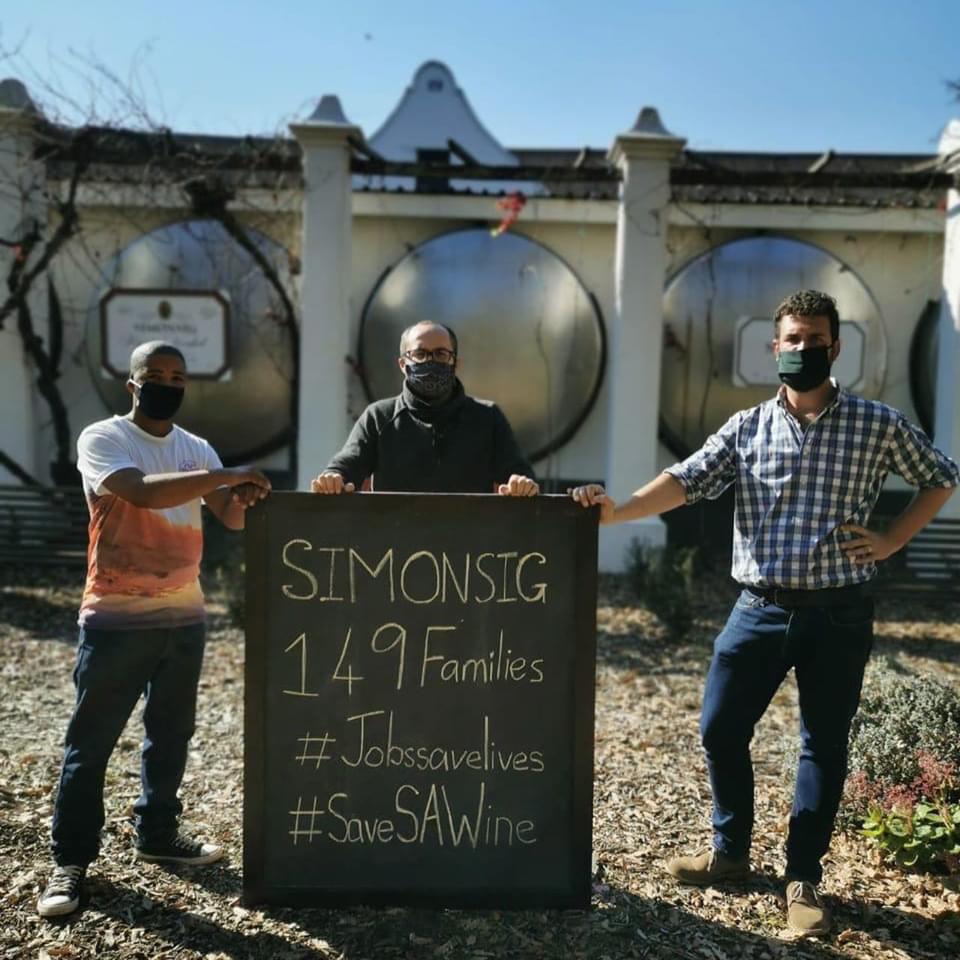
Wine farms have joined the #jobssavelives campaign, drawing attention to the number of families dependent on their businesses for survival.
Again, the export market seems to be the only opportunity for some respite. While Other countries have not also banned alcohol sales there is also some surplus in the market. For instance, sales of French Champagne are down due to the cancellation of weddings and other celebrations due to the pandemic.
We can only hope that because of the lower value of the rand South African wines will be able to increase either their profit share or market share.
This years Top Wine Classification provides an assessment of wine quality and interest value between 2010 and 2019. The requirement is for consistently good performance over a ten year period.
To be eligible for the Classification, updated annually since 2004, wines must have earned good to excellent reviews for at least three vintages during the 10-year period under review. The focus is on the country’s leading outfits, those regularly on top form, their wines judged top-notch again and again, year after year. The critics include experts appointed for the Decanter World Wine Awards (UK), the International Wine Challenge (UK) and IWSC (UK), Platter’s SA Wine Guide (5 Stars and Highly Recommended), the Six Nations Wine Challenge (AU), the Trophy Wine Show (SA), the Veritas Awards (SA) and the Michelangelo awards (SA) – to mention just some of the panels.
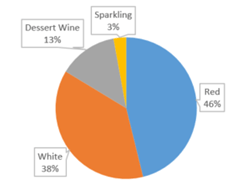
My first thought on looking at the above chart was, “Oh, but that’s just representative of wine production in South Africa.” But on a closer look at the statistics, I found it was not so. In 2019, 32% of wine produced in South Africa was red and 68% was white. It therefore stands to reason that our red wines are of higher quality, if 46 of the top 100 wines were red.
Wine buying tip 1: Buy Red wine
The Cap Classiques making you the 3% of top wines in the sparkling category is slightly more than production. Dessert style wines are also slightly over represented.
Wine buying tip 2: Buy Cap Classique, Cape Vintage Port and Noble Late Harvest
I am pleased (smug) to say this aligns with my pallet and my wine collection. I very seldom buy white wine. But if I were going to buy these wines, which varietals or styles would I buy?
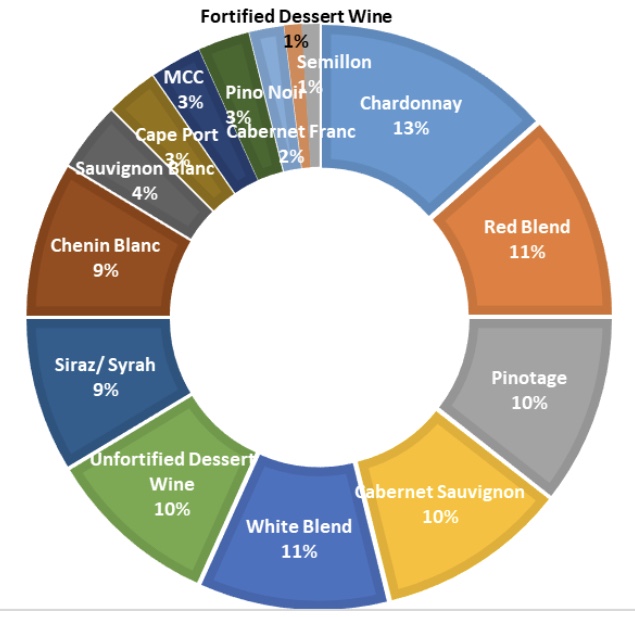
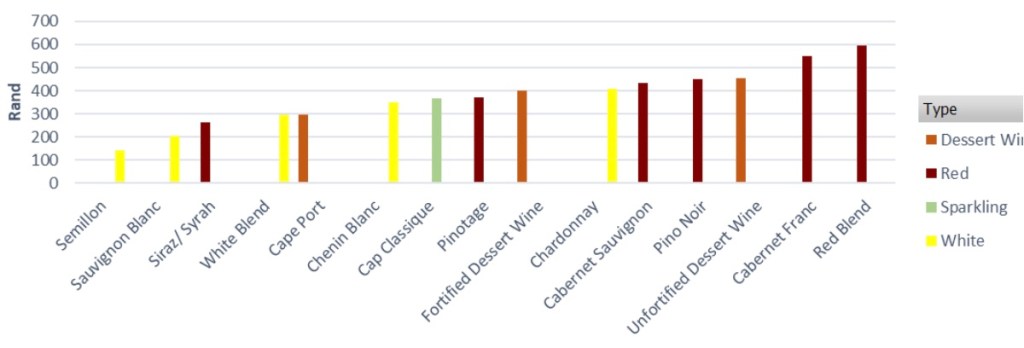
Breakdown of the 100 Top Wines in SA, 2020 by style or varietalAverage price of the Top 100 Wines in South Africa by varietal
I put these two graphs next to each other because, if you are anything like me, you are probably also looking for maximum bang for your buck. Don’t get me wrong, none of these wines are cheap – I know my dad would have a heart attack seeing these prices! But if you were going to fork out the money what would be a good bet?
From the above Chardonnay (around R400) and a red blend (around R600) would be likely to deliver good quality but with quite a hefty price tag. The hefty price tag might be justified given the aging potential of a red blend and these days you might also want to age a Chardonnay. I like the Pinotage option. It is less expensive (just over R300) and still quite likely to be a top wine.
I have become quite a fan of South African Shiraz which comes in at the lowest average price in the red wines. Depending what you are looking for, these wines can be aged longer than a Pinotage but some come with gentle tannins and a screw top for enjoying now (Eagles Nest, De Gredndal).
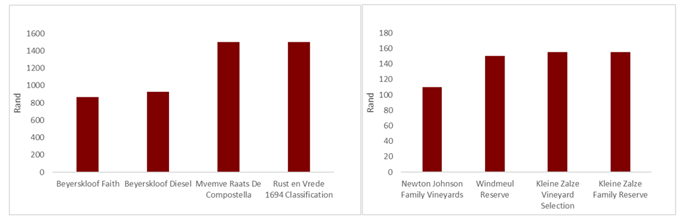
Comparing the Four Most Expensive Reds to the Four Cheapest Reds on the Top 100 Wines list 2020
As can be seen above the spread in cost across these top red wines is substantial. Good wines can be bought for under R150 a bottle but if you are looking to impress, you might spend ten times that! Three out of the four top reds are Red Blends.
Dessert wines of all types have excellent aging potential. If you are looking for something special to put away for a long time, the Cape Vintage Ports are a good option. That being said, Nederburg Winemaster’s Nobel Late Harvest is a great option at R130 a bottle (you might even want to drink it now). Of course if what you are looking for is to impress Klein Constantia’s Vin de Constance (R1,189) often sells out and would make a great investment.
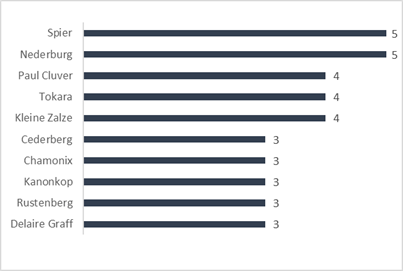
Some wine farms performed well across a variety of categories.
Spier and Nederburg each had five wines in the top 100. Both are reasonably priced, aside from the Ultra Premium wines, where they charge a premium. Kleine Zalze’s wines are probably the best value for money and four make the cut.
So overall, which wine would I buy if I could buy only one? It would definitely be a Kleine Zalze Cabertnet Sauvingnon. But with two in the Top 100 it is a difficult choice. Here I referred to Platters: nope, both had 4.5 stars in 2018, ratings out of 100 scored 93(Family Reserve) and 94(Vinyard Selection), so only a very slight differentiation. So let me try Vivino. On Vivino the Vineyar Selection scores an average of 3.9 out of 5 whereas the Family Reserve scores 4.2. Marginal again. So if pushed to choose, I would go for theKleine Zalze Family Reserve Cabernet Sauvignon. I trust the the ratings of everyday consumerson Vivino a little more than the wine snobs on the Platters panel. I think this wine is both good value for money and a great wine to age, perhaps making it a good candidate as an investment wine.
Here is the full list:
TOP 100 – 2020 CLASSIFICATION
WHITE WINES
CHARDONNAY Chamonix Reserve DeMorgenzon Reserve Eikendal Groot Constantia Hamilton Russell Jordan Barrel Fermented Jordan Nine Yards Kershaw Oak Valley Groenlandberg Paul Cluver Estate Paul Cluver Seven Flags Rustenberg Five Soldiers Tokara Reserve Collection Stellenbosch Uva Mira Single Tree
CHENIN BLANC Beaumont Hope Marguerite Botanica DeMorgenzon Reserve Ken Forrester FMC Kleine Zalze Family Reserve Old Bush Vine Perdeberg Dry Land Collection Barrel Fermented Sadie Skurfberg Spier 21 Gables Stellenrust Barrel Fermented
SAUVIGNON BLANC Cape Point Reserve Ghost Corner (Cederberg) Kleine Zalze Family Reserve Sur Lie Tokara Reserve Collection Elgin
SEMILLON KWV Mentors
WHITE BLENDS Cape Point Isliedh Constantia Glen Two Flagstone Treaty Tree Sauvignon Blanc Semillon Mullineux Old Vines Nederburg Ingenuity Nitida Coronata Integration Rall Sadie Palladius Spier Creative Block 2 Tokara Director’s Reserve Vergelegen G.V.B
SPARKLING WINES
CAP CLASSIQUE Desiderius Pongrácz (JC Le Roux) Graham Beck Brut Blanc de Blancs Villiera Monro Brut
RED WINES
CABERNET FRANC Raats Family Warwick
CABERNET SAUVIGNON Cederberg Five Generations Delaire Graff Reserve Eikendal Kanonkop Kleine Zalze Family Reserve Kleine Zalze Vineyard Selection Nederburg Two Centuries Neil Ellis Jonkershoek Rustenberg Peter Barlow Stark-Condé Three Pines
MERLOT Shannon Mount Bullet
PINOT NOIR Chamonix Reserve Newton Johnson Family Vineyards Paul Cluver Seven Flags
SHIRAZ / SYRAH Boekenhoutskloof Syrah Cederberg De Grendel Driehoek Eagles’ Nest Hartenberg Gravel Hill Reyneke Reserve Red Rustenberg Buzzard Kloof Syrah Saronsberg
RED BLENDS Beyerskloof Faith Chamonix Reserve Troika Delaire Graff Botmaskop Kanonkop Paul Sauer KWV Mentors Orchestra La Motte Pierneef Syrah Viognier Mvemve Raats De Compostella Rust en Vrede 1694 Classification Saronsberg Full Circle Spier Creative Block 3 Spier Creative Block 5 Tokara Director’s Reserve
SWEET WINES
UNFORTIFIED DESSERT Delheim Edelspatz Noble Late Harvest Fairview La Beryl Blanc (Straw Wine) Fleur du Cap Noble Late Harvest (Bergkelder) Groot Constantia Grand Constance (Natural Sweet) Klein Constantia Vin de Constance Natural Sweet Mullineux Straw Wine Nederburg Edelkeur Chenin Blanc Noble Late Harvest Nederburg Eminence Noble Late Harvest Muscadel Nederburg Winemasters Noble Late Harvest Paul Cluver Riesling Noble Late Harvest
FORTIFIED DESSERT Nuy White Muscadel
CAPE PORT Boplaas Cape Vintage Reserve De Krans Cape Vintage Reserve Delaire Graff Cape Vintage
Last night President Cyril Ramaphosa addressed the nation. He voiced his concerns about the increasing number of COVID-19 cases and announced the reintroduction of an alcohol sales and transport ban, amongst other measures.
This is a necessary measure as hospital beds fill up with CoVID-19 patients and ICUs in both the private and public sector struggle to cope. We as South Africans have also demonstrated our problems with alcohol fueled violence, with ICUs being burdened since the Alcohol van was lifted at the end of May.
While the need for the ban is acknowledged the impact on the economy can’t be denied.
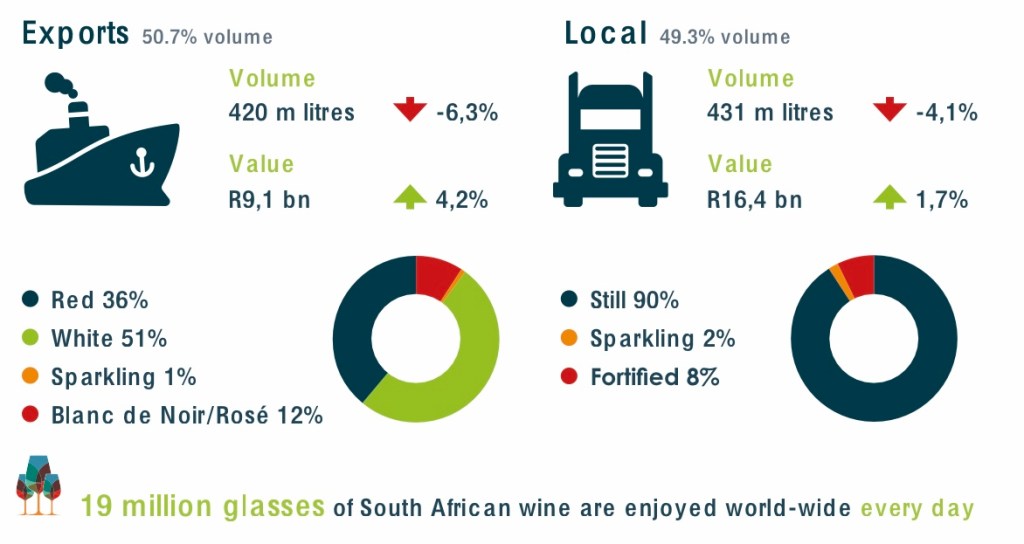
Overview of the South African wine market, infographic
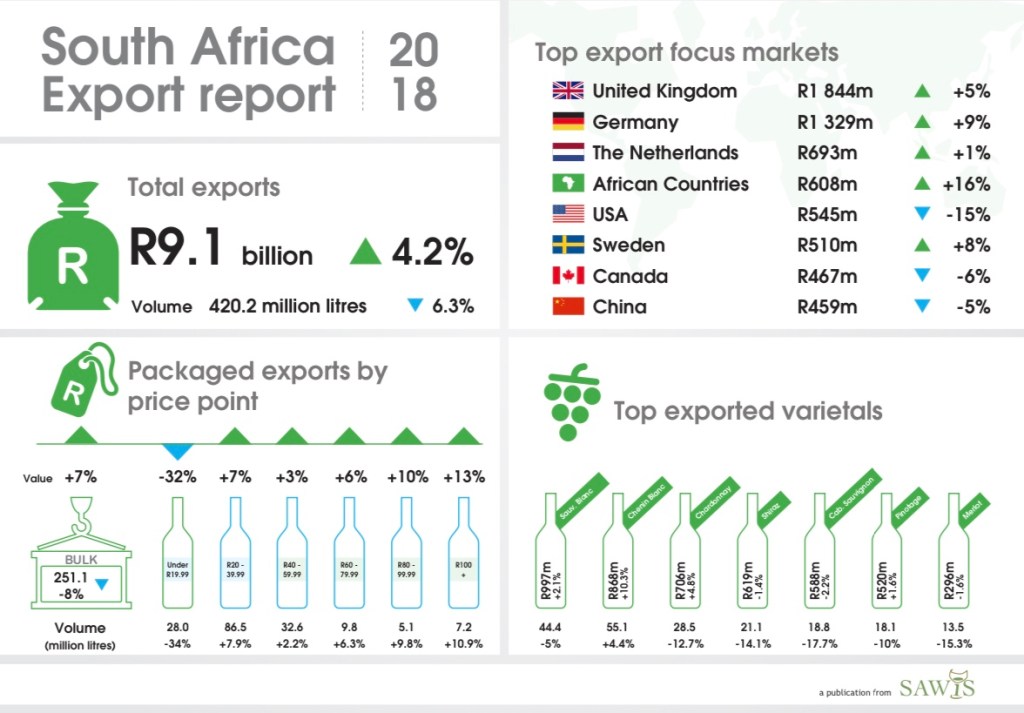
It is a relief that wine exports aren’t directly impacted by the ban. While exports make up just over half of production volume, it was responsible for 36% of value in 2018. While some of this value can be preserved, Cape Town’s port has been operating at reduced capacity to adhere to COVID-19 related regulations. There is a backlog of shipments with the port operating at an estimated 50% of capacity. The silver lining may be that the devaluation of the rand may increase profits for this market.
The local market however, will be more impacted with at least three months of lost sales and the loss of the Restuarant market. The local market made up 74% of the market value with about half the volume. This shows the relatively higher value of the South African market and the greater impact of loss of sales. This probably also refers to higher end wines which are more labour intensive due to practices like harvesting by hand and hand hand riddling.
South African Wine Exports, Graphic Analysis
The alcohol ban is therefore likely to have a devastating effect on the wine industry. The profit margin from wine sales is estimated at 2% for the industry in recent years. This will be severely impacted by the drop in sales that will result from the ban. As wine farms struggle to remain profitable they are likely to introduce cost cutting measure, including job cuts.
Farm workers will probably be most impacted. These workers are predominantly concentrated in the Western Cape. Similar to the wine industry the fruit growing sector in the Western Cape is also impacted by port capacity. Farming communities are likely to be disrupted, in the DA run Western Cape, ahead of local elections in 2021.
As profit margins in the wine industry have been eroded, wine tourism has grown to support the industry. Given the impact of COVID-19 regulations on the tourism sector, the impact will be even more devastating.
The impacts of COVID-19 restrictions, especially the alcohol sales bans, will have far reaching impacts on wine farming communities. Measures to revive the industry have not been proposed by government and will likely come from the private sector. Hopefully this will be supported by the weak rand and export demand.
As part of the COVID 19 lockdown response here in South Africa alcohol sales were banned. When sales reopened most wineries offered specials and although we had not run out of wine (thankfully) we thought it was a good opportunity to stock up and support the local wine industry.
Prices
I made a rule for myself not to buy anything that wasn’t marked down by at least 20%. The best deal I came across was Spier, who offered 25% of if you bought a minimum of 6 cases.
Interestingly, the big retailers were not offering discounts. I assume this is because they were making sufficient profits out of people coming in to stock up. Keep in mind Pay ‘n Pay had a one day special last year where they offered 25% off and Checkers usually has a special towards November, where if you buy 5 bottles the 6th one is free (although this was limited to certain brands last year).
Most of the wine I chose was from this article https://insideguide.co.za/cape-town/wine-specials/ but I perused the websites of my favourite wine farms and joined a few wine clubs. I also ordered some wine from One day Only and Daddy’s Deals.
Choice
I used the 2019 and 2020 Platters wine guide to formulate my choices. My general rule of thumb was to buy wines 4 stars and up (I have become somewhat of a wine snob). I tried to practice the art of “champagne taste on a beer budget” and maximise the stars:rands ratio – yes I’m a dork!
Most farms had it set up so that you had to buy by the case. I don’t know about you, but I cannot afford to buy ultra premium wines by the case. However, where I was able to buy a bottle of investment wine at a good price I did here and there.
Delivery
It’s taken a month but today the last case of wine was delivered. Some wine farms were clearly struggling with the backlog: Steenberg disappointed by delivering the wrong wine and Glenwood delivered our order twice. Two wine farms packaged ultra premium wines badly and they arrived with stickers all over their damaged high end packaging.
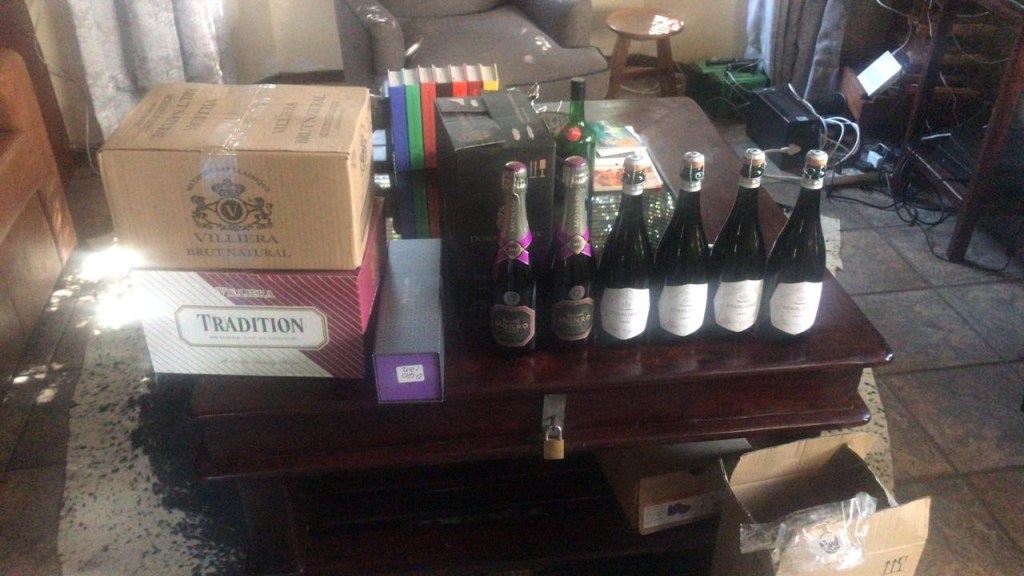
On the other hand Villiera surprised us by sending their wine ambassador to deliver our wine in person, with an extra bottle of their Cab Franc which we can’t wait to taste. They invited us to a Zoom tasting for Chenin Day and brought us a bottle of Chenin for the occasion.
All in all I have enjoyed the process of choosing and logging my wines. I can’t wait to drink them!



 Don’t Cry Over Spilt Wine